A Decade of Prevention: 6.6 million youth and counting
Twenty years ago, the head of her child’s middle school invited Stanford University Professor Bonnie Halpern-Felsher to speak about her research on adolescent risk behaviors. As the founder and director of the REACH (Research and Education to Empower Adolescents and Young Adults to Choose Health) Lab, Halpern-Felsher chose to talk about substance use, particularly tobacco.
“The head of the school, Stephen Smuin—and that's important because he became my co-investigator—said to me, ‘Don't just give a lecture; Have activities and stuff.’ Being a professor, I looked at him and said, ‘I don't know what you're talking about’, because we’re talking heads as professors,” she muses.
From a Middle School to the World
The middle school talk went so well that she immediately saw the potential and wondered if Smuin might collaborate on a grant. “He was a middle school educator who knew how to develop curriculum but knew nothing about tobacco. And I knew everything about tobacco, but nothing about teaching kiddos,” says Halpern-Felsher. Teaming with consultant Ira Sachnoff, they developed a curriculum that incorporated evidence-based information on tobacco use and teen behavior, with a goal of prevention.
“My research on teen decision-making, funded by TRDRP [Tobacco-Related Disease Research Program], showed that teens were balancing risks and benefits,” Halpern-Felsher says, yet she noticed most educators—and other tobacco education curricula—focused on ‘the really terrible long-term risks’ of substances. “If anything, it's the perceived real benefits, both physical and social, short and long term, that are more important to them: you might smell, or you might get into trouble, but you might also look cool.”
If you don’t address these, Halpern-Felsher reasoned, you miss an opportunity. Worse, “If you only tell teens, ‘This is horrible, you're going to die’ and they like it—which they often do—then we look like idiots,” she says. In September 2016, the team launched the Tobacco Prevention Toolkit, a collection of free online lessons for middle and high school students funded by TRDRP and the California Department of Education’s Tobacco Use Prevention Education (TUPE) program.
Since then, “[the toolkit] evolved into multiple curricula, all using the same style and pedagogy: no scare tactics, no blame and shame … and always talking about the balance of risks and benefits,” explains Halpern-Felsher. In 2019, the REACH Lab released the Smart Talk Cannabis Awareness & Prevention Toolkit, and in response to the growing epidemic of e-cigarette use in youth, the lab launched their flagship You and Me, Together Vape Free curriculum in 2022. They released the Drug Prevention and Intervention Toolkit in 2023, which includes a comprehensive drug education, prevention, and intervention curriculum called Safety First. They have also released lessons aimed at elementary schools.
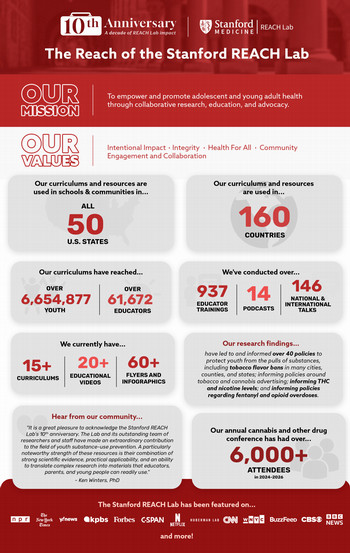
All told, these resources have reached more than 6.6 million youth in 50 U.S. states and 160 countries. “That's just what we can estimate,” Halpern-Felsher says, since all curricula are free and readily available online.
What Exactly is a Toolkit?
All toolkits include lessons on health, particularly how substances affect adolescent bodies and brains, through a harm reduction lens. That means they aim to meet kids where they’re at, empowering them with information on reducing their own risk, rather than shaming anyone who might use nicotine or other substances. “We come with a ‘Just say KNOW’ perspective,” explains Halpern-Felsher. Resources for quitting are available, as well.
Media literacy is also a core component of every toolkit. In fact, REACH Lab research has shown that avoiding being ‘duped’ motivates many adolescents. Various lessons provide opportunities for critical thinking, such as identifying techniques used by advertisers to target different ethnic communities, and even youth—despite these products not being legal until age 21—with ads depicting influencers and celebrities having fun, being attractive, and looking cool. Most toolkits also incorporate a conservation message, discussing the environmental impact of disposable vape cartridges and cigarette butts—the most littered item in the world.
Teachers can select which topics to cover and for how long with each toolkit. At first, says Halpern-Felsher, “we had like a ‘choose-your-adventure’ because people were saying educators don't want to be told what to do.” But they found some educators preferred ready-to-use guidelines, so they developed those, too. Each lesson includes Canva slides with embedded videos and stopping points for activities and discussions.
Lessons not only meet California and National common core standards but are also practical, insightful, and effective. One lesson teaches “refusal skills,” where kids can practice lines from, “I have a sore throat.” to “I can’t afford to get addicted to vaping,” to “I don’t want to make Big Tobacco richer by getting hooked on vaping.”
Each toolkit includes various resources to enhance the lessons: color posters to print and use, modifiable social media posts to share, stickers to order for students, and a template for a parent letter. The REACH Lab has regular live online training sessions for educators.
The team also created the Healthy Futures Alternative to Suspension program, where a student can take a course about substance use, either in a group setting or as a self-paced individual course. “That's important because we don't want to suspend kids,” especially if they're addicted or dependent.”
Evolving as the World Evolves
“We're constantly evolving as the world evolves,” says Halpern-Felsher. The REACH Lab requests—but does not require—participating schools and classrooms to submit students’ pre- and post-surveys about their knowledge on each topic, enabling researchers and educators to test a lesson’s effectiveness.
“That gives the educators de-identified data on changes in knowledge, attitudes, and intentions,” says Halpern-Felsher. For each school, teachers can access de-identified classroom data from the pre- and post-surveys, school administrators can access schoolwide data, and the REACH lab can see all schools’ data.
With everything fully online, the REACH lab can readily modify lessons with said feedback and can incorporate new scientific research. In fact, the lab just launched revamped You and Me and Smart Talk curricula in early September, replacing potentially distressing imagery and giving greater emphasis to diverse learning styles, neurodiversity, and different experiences.
“This updated curriculum addresses key factors in youth e-cigarette use… addressing misperceptions, strengthening refusal skills against marketing and peer influence, addressing stress that can lead to use, improving coping skills, and reducing both intentions and use of e-cigarette products,” says Halpern-Felsher. For the flagship You & Me curriculum, updates “emphasize that all e-cigarettes, including non-nicotine e-cigs, and all tobacco/nicotine products, can harm the developing brain and body.”
“It's hard to do this work,” says Halpern-Felsher. “Aside from the usual stuff—it takes a lot of effort to build a curriculum, making sure it's fun and cool, and making sure that it's accessible to all youth. It's also hard because we get so much pushback from the industry.” She and her team have no intention of stopping.
Written by Wendee Nicole Holtcamp
MEDIA CONTACT: trdrp@ucop.edu