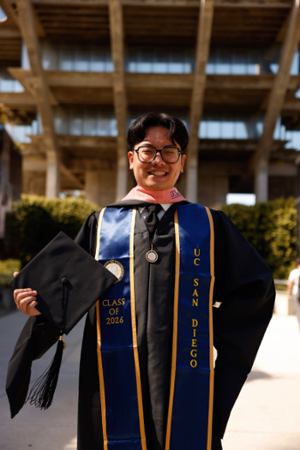
TRDRP Trainee Spotlight: Mr. Luan Nguyen
Luan Nguyen | Community Health Specialist and Coach
UC San Diego
“…Experiences taught me at a young age that having healthcare services available does not necessarily mean that those services are truly accessible to everyone.” – Luan Nguyen
Background and Inspiration
Born and raised in Vietnam, this Luan Nguyen moved to the United States at age 10. Watching their family navigate healthcare with limited English and few interpreter services sparked an early interest in health equity. Those experiences shaped a commitment to understanding—and addressing—the barriers immigrant and non-English-speaking communities face when seeking care.
That commitment led to a Bachelor of Science in Public Health and a Master of Public Health, both with a focus on epidemiology, at UC San Diego. Their research experience spans opioid overdose surveillance, cognitive health among breast cancer survivors, and Alzheimer’s disease in Vietnamese-speaking populations.
Tobacco-related disease also carries personal significance. Several relatives smoked for many years, and some grandparents and other family members died from lung cancer. Seeing tobacco use across generations highlighted how family, cultural expectations, social influences, and access to cessation resources can shape health.
Today, he works as a Community Health Specialist with DAP Health and as a community health coach with the California Diabetes Prevention Project, primarily supporting Vietnamese-speaking patients. They are also completing prerequisites to pursue a Master of Science in Nursing, with the goal of connecting public health research to culturally responsive patient care.
Research that Resonates
Their TRDRP-funded project at Family Health Centers of San Diego explores why Vietnamese-speaking patients may not complete lung cancer screening, even when they are eligible or have received a referral for a low-cost CT scan.
Interviews with patients and primary care providers identified language barriers as the most consistent challenge. Other obstacles included limited understanding of screening, scheduling and transportation difficulties, reliance on family support, and inaccurate documentation of smoking history. These findings point to opportunities for Vietnamese-language support, patient navigation, scheduling assistance, and improved documentation to help eligible current and former tobacco users complete screening.
Sharing a language and cultural background helped Luan connect with participants and create space for candid conversations. A visit to Vietnam, including a service trip in rural communities, further informed the work. Conversations about smoking, cessation, and healthcare access helped refine interview questions to better reflect participants’ experiences before immigrating.
TRDRP support also provided conference opportunities and mentorship that strengthened their research skills and career development. These experiences reinforced a central goal: translating research into practical solutions that reach underserved communities.
Advice for Aspiring Researchers in Tobacco Control and Prevention
Their advice begins with listening. Before designing a study, researchers should take time to understand the community’s beliefs, cultural values, everyday experiences, and priorities. Building relationships with community leaders, trusted organizations, and community champions can help ensure that research asks meaningful questions.
Culturally and linguistically appropriate communication is essential, and translation alone may not be enough. Researchers must also recognize the broader conditions influencing tobacco use, including stress, financial circumstances, family relationships, social norms, and access to cessation support.
Finally, Luan encourages researchers to plan for practical impact from the beginning. Remain willing to adjust when communities identify unexpected barriers, share findings in accessible ways, and work toward realistic improvements in education, services, and resources for the people who made the research possible.
Funding: This research was supported by TRDRP grant T35CR9405H - Enhancing Primary Care Workflows To Improve Lung Cancer Screening Engagement For Low-Income Patients (Co-PIs Strong and Godino).
Written by: Tashelle Wright, PhD, MSPH, TRDRP Associate Program Officer